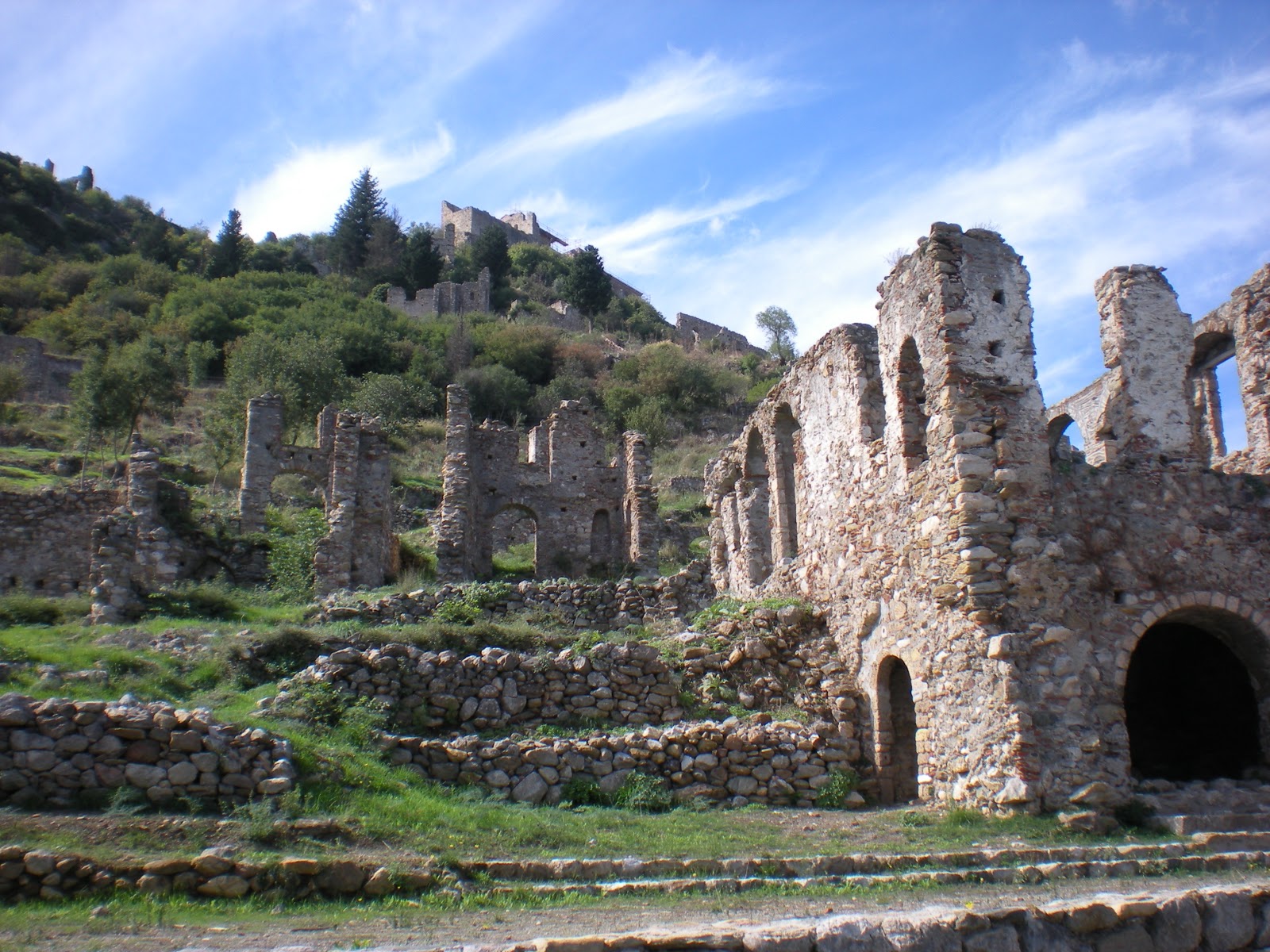
So, Friday morning, far too early, we got on the bus and left Sparta for Olympia. The bus ride was much longer than anyone really expected, and we ended up getting to Olympia too late to do both the museum and the site in the same day, which pushed our schedule back a little bit for the rest of our time in the Peloponnese. I wasn't thrilled, as two full days in Delphi had been a very exciting prospect, but as it turned out, I wouldn't have spent a minute less in Olympia, so no worries.

The Bus ride took us over these mountains and gave some rather spectacular views when the rocking motion didn't want to make us close our eyes from fear and/or hypnosis.

Our quaint "rest stop" along the way. Not your typical tour bus pit stop. :-)

The spring where we all filled our water bottles. Also, the best water I've had in Greece yet!

First view of the site of Ancient Olympia. The columns have been stood back up, but almost none of that is reconstructed stone work. Truly incredible!
For those who don't know: Olympia is the original site of the Pan-Hellenic Olympic Games, beginning in 776 b.c. This means gymnasiums (pictured above), temples (pictured below), stadiums (pictured far below) and lots and lots of treasuries and offerings from all over the Ancient Aegean world, including Grecian colonies in other areas of the world. The site is huge and splendid in every way, and we didn't being to cover it in the three hours we spent there.

Frontal view of what remains of the Temple to Olympian Zeus, plus reconstructed full-scale column and scale tourist (you can just see him in white on the left side of the picture if you squint.)

JK sizing up one of the column pieces from the original temple. That is a mid-size cross section of one enormous column. Many laying around us were even larger.

Across the way from the temple to Zeus was a temple to Hera, his wife. It was a little smaller, of course, but still very prominent.

We actually were able to go a little inside of the temple to Hera and look around a bit at what the inner structure of an ancient temple might be (sans grass, of course).

This round structure (only part of which is re-stood-up here) is called a Tholos (which is Greek for "round thing"). No one knows what they were used for, but they seem to crop all over in the darnedest places. They're usually called "religious" and left at that.
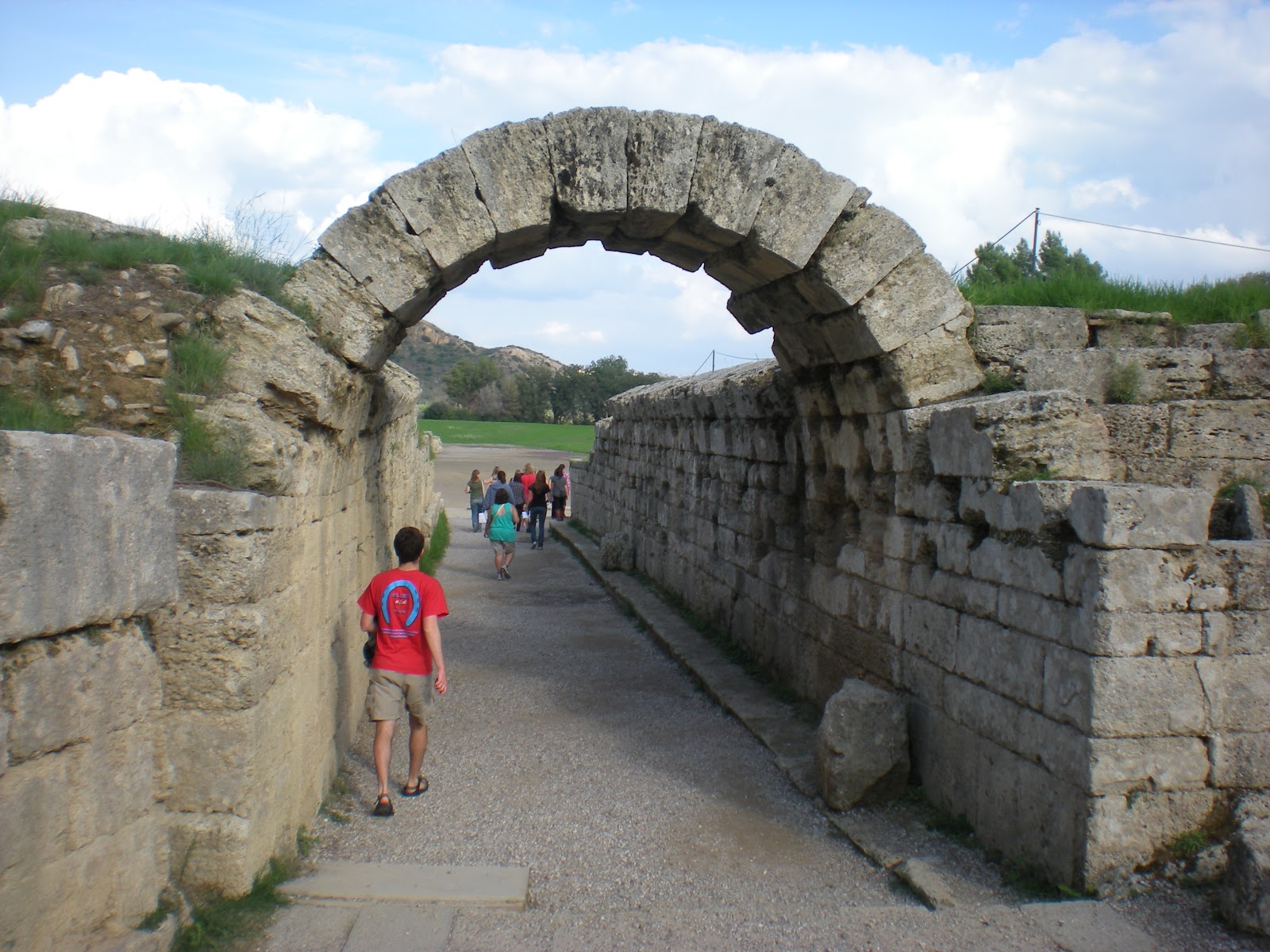
The grand entrance to the Olympic Stadium. Even in 400 b.c. everyone's trying to out-do each other for showiness at the Olympic Games.

And the Stadium itself. We held a race where we all had to run barefoot across the stadium and back, just as they did in ancient times. Surprisingly, the guards were fine with this (apparently it's bad form to preform in a theater, but isn't to run on a track. Oh well.) The stadium is about 191.7 meters long, so I was a bit winded after that sprint, but I was proud not to come in last.
We stayed in Olympia that night without much event or ado, got up early again and went to the Museum attached to the site on Saturday morning. The museum was fantastic, containing, very much intact, the friezes and pediments from the original temple of Zeus as well as some lovely roman sculptures, a great bronze collection and the famous statue of Hermes standing with the baby Dionysus on his arm (no picture because there were already quite enough in this post!) It was a lovely walk through and I would have liked more time there, but I guess I just have to go back later.
After racing out of the museum around noon, we all grabbed our lunches in a little town called Nafpaktos on the way to Delphi. Nafpaktos, as far as I could tell is a town on the water that makes most of it's money trapping tourists with it's picturesque beach-front tavernas as they make their way toward Delphi. There is one main street and beyond that it gets a little run-down and shabby. There was also a creepy looking state-fair sort of attraction being set up, which did not help the general atmosphere. I was too busy thinking about Delphi to pay too much attention to the town, anyway.
We got to Delphi just in time to do a small portion of the site (which is so large that is divided into an upper and lower section anyway) and to have dinner before checking into the hotel.

The Tholos structure at Delphi. No one knows what this was used for either.

View overlooking the remains of two temples and a treasury, looking back on the Tholos.
I had a quick dinner that night and proceeded to walk around the town essentially on my own. The "towns" at these sites (with the huge exception of Sparta) all tend to be little tourist traps with hotels, shops and tavernas, and no real sign of the people who live there. Delphi, unfortunately, was no exception to this, but I did go into one store (and spent about an hour there) where the man running the shop was very surprised to find I knew a little Greek. He had the most lovely chess sets, which I would have gladly bought could I explain the 75€ to myself and figure out how to get one home, but we got to talking over the items (in Greek, whenever I could) and then about family life and what I was doing in Greece. He wanted to invite me to dinner, and was very sad that I had already eaten. I got to meet his precious daughter, Eirene (which means "Peace" at least in Ancient Greek), and we listened to Leonard Skynard and Johnny Cash in his shop together. His colleague also dropped by the store for a while and they explained their mission to find the Nymphs, Druids and Fairies on top of Mount Parnassos (the great mountain that Delphi is founded on top of), and showed me pictures of what I think were fireflies inside the caverns. It was fun to talk to them at least, and the colleague told me that I had a very positive aura and was no ordinary tourist. That made me feel good, even if it was a sales pitch, which I'm not sure of even now.
Sunday morning was another early one, but with good reason. We had to complete the Delphi Museum and most of the site by about noon. The museum was fine, though nothing spectacular with a few exceptions of a Sphinx that stood about 8 ft tall, two very famous Kouros (young male nude) statues, and the friezes and pediments from around the temple of Apollo and the Athenian treasury. It was fun, but I'm glad for the sake of seeing the actual site that we only spent about an hour inside.
Then there was Delphi.
For those who don't know, Delphi is the site of the most famous Oracles and Prophecies of the ancient world. People from all over Greece, the Byzantines, Italy, Egypt and as far as Asia and - I think - Gaul came to visit this Oracle for advice. It was said to be founded by Apollo himself, who was a god of prophecy among many other things, and a Pythia (a very special priestess) was chosen to sit on the tripod and receive Apollo's messages of the future. She would go into a trance (possibly induced by chemical vapors rumored to be on the site) and speak in tongues, which would then be translated by the surrounding priests into a prophecy in hexameter verse. Welcome to the ancient version of rock-paper-scissors. It also held athletic games similar in scale to the Olympic games every four years and was one of the best known sites of the Ancient world, often called the naval of the world in it's heyday.

First view going up the mountain. This site is immense!

Picture of the Athenian Treasury along the way up. This is a reconstruction, but from what I understand they had a fair bit left to work with while reconstructing the site.

The enormous altar of Apollo, with JK standing in for scale. It was less massive from the other side, but still looked more like a defensive wall than an altar.

A special secret tunnel one level below the temple. No one really knows it's purpose (though it was probably something to do with the smoke or general mysticism of the Oracle). When we passed by there was no guard and no rope, so our professor encouraged us to go through which I did (twice). It was actually quite a mystical experience as, even though it is a short tunnel, the structure of it is such that there is a point with no light whatsoever. A priest/ess or messenger might feel truly connected to the god at such a moment, so we felt it might serve as a right of passage of sorts as well. The second time I went through, a guard very politely asked me to get out. I was disappointed, as the site still wasn't roped off, but I understand why they don't encourage people going through.

The other entrance/exit of the tunnel. There is a third, but I don't seem to have snapped a shot of it. (I am told by a roommate that she got a picture of me exiting the tunnel, which I will steal from her in due time.)

A small view of the site from within the tunnel. It's pretty cramped in there, but it's fun to crawl through. Reminds me of an ancient Discovery Zone or McD's Playplace of sorts.

The immense temple of Apollo to go with his enormous altar. The ramp is still in just gorgeous condition.
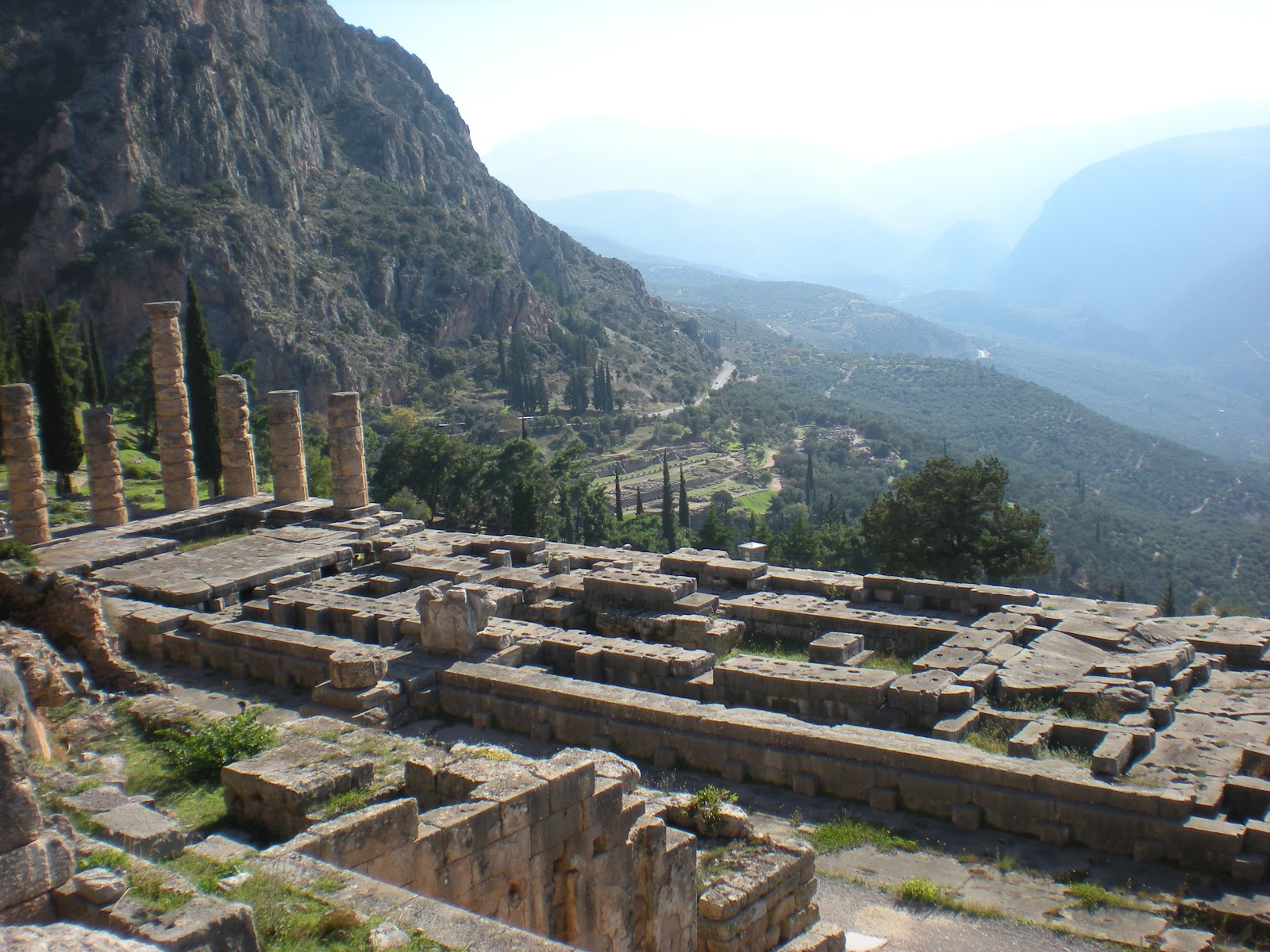
Ariel view of the temple and its inner structure. This thing is so big. I cannot stress that enough. It's a fair minute-long walk to pass by it lengthwise.

The theater at Delphi, which is less impressive than that at Epidaurus, but still quite nice.

Some remaining column pieces at the far end of the site. We all got to explore on our own for about an hour between the lecture and time to leave. I was extremely grateful for that.

Looking along a drain pipe back towards the main site and JK, ES and LV from my group. Isn't the scenery overwhelming? It's hard to pay attention to the little ruins with the giant mountains sitting there.

Looking down on the Athenian treasury and surrounding ruins from the temple level.
We left Delphi around 12:30 and stopped for Lunch just a short while later in Arachova, which is another town which seems to make most of it's money from tourism. It did seem like more of a town existed that was readily available to tourists, however, which was a refreshing change, especially getting ready to come back to Athens, even for a little while, where tourism is only the norm in the summer.

We returned to Athens about 5:00pm (around 4 hours ago now) and I am very ready for bed. M, G and I are all going to Santorini tomorrow morning, and our boat leaves at 7:25, meaning we have to be at the port at 6:15, so we have to leave the apartment around 5:30 at the latest, so we have to be up by... by... early... *sigh*. I'd best go to bed now. I do not know at all whether or not our hotel/hostel will have internet, and may decide against bringing my computer entirely. We shall see. There will be pictures Friday at the latest.
I hope you all have enjoyed your virtual tour of the Peloponnese. Please gather all of your thoughts and exit the web-page carefully. Thank you again and Καληνύχτα!